
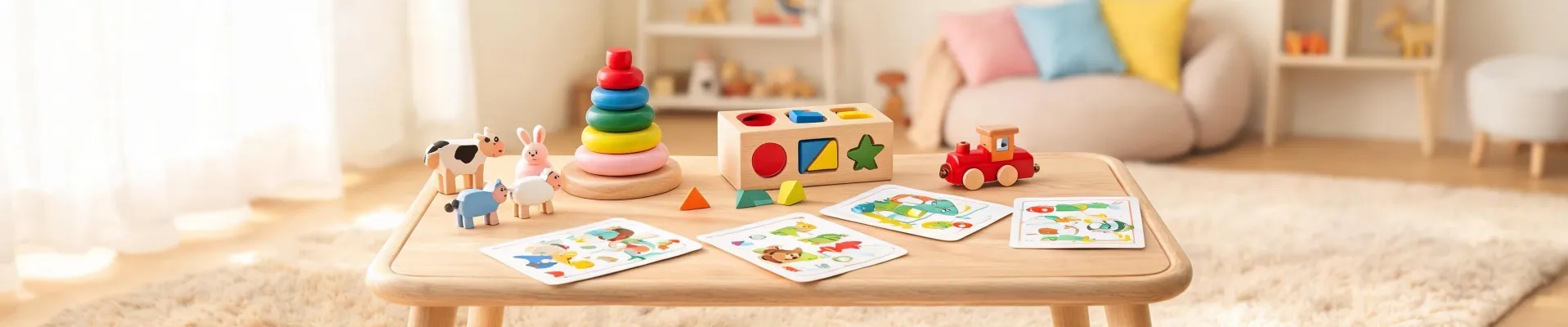
Hape Country Critters Wooden Activity Cube: Five Sides of Safe, Engaging Toddler Play
2026-08-18 by Miriam Adler
-
The Real Question: Which Activity Cube Actually Grows with Your Toddler?
-
Material Safety: The Non-Negotiable First Check
-
Play Value: What Five Sides Actually Give You
-
Brand Reliability: When Trust Speaks for Itself
-
Decision Framework: Matching the Cube to Your Space and Child
-
Verdict: Who Should Buy the Country Critters Cube Today
Which activity cube actually earns a permanent spot on your living room floor? Walk into any toy store or scroll through any online marketplace and you will find wooden cubes in every price range, each promising to boost fine motor skills, spark curiosity, and survive toddler enthusiasm. The options blur together: bright farm animals, pastel shapes, spinning gears, and bead mazes. Many parents pick based on price or a cute photo, only to discover months later that the paint chips easily or that the cube offers only two or three engaging activities. The real selection problem is not which brand has the most cheerful packaging, but which toy can grow with a child as they move from sitting up to walking and talking. That means looking beyond surface appeal and comparing three concrete dimensions: material safety, play value, and brand reliability. Once you have a way to evaluate those, the decision becomes far less stressful.
The Real Question: Which Activity Cube Actually Grows with Your Toddler?
Which wooden activity cube actually earns a permanent spot on your living room floor? That is the question many parents face. Walk into any toy store or scroll through any online marketplace and you will find wooden cubes in every price range, each promising to boost fine motor skills, spark curiosity, and survive toddler enthusiasm. The options blur together: bright farm animals, pastel shapes, spinning gears, and bead mazes. Many parents pick based on price or a cute photo, only to discover months later that the paint chips easily or that the cube offers only two or three engaging activities. The real selection problem is not which brand has the most cheerful packaging, but which toy can grow with a child as they move from sitting up to walking and talking. That means looking beyond surface appeal and comparing three concrete dimensions: material safety, play value, and brand reliability. Once you have a way to evaluate those, the decision becomes far less stressful.
One candidate that keeps surfacing in these comparisons is the Hape Country Critters Wooden Activity Cube. The product name appears in Hape’s own catalog with a clear descriptor: a five-sided toddler learning toy. That simple label matters because five sides is not just a marketing number; it is a structural commitment to variety. Instead of a single busy face, the cube surrounds a child with different activities on each side, so a toddler can rotate the toy and find a new challenge without losing interest. The Country Critters version leans into an animal theme, with friendly woodland characters that invite naming, pointing, and storytelling. For a parent who is tired of single-purpose plastic gadgets that clutter the playroom, this wooden cube offers a consolidated alternative. It still requires enough floor space and a child who is ready to explore, but as a starting point in the comparison, it checks the box for a recognized brand and a design explicitly built for toddler learning.
Material Safety: The Non-Negotiable First Check
Material safety is the non-negotiable first check for any toy that will end up in a toddler’s mouth. Before you look at how many activities a cube has, you need to know what it is made of and what kind of paint is on it. The key questions are straightforward: Is the wood sustainably sourced? Are the finishes non-toxic and free of harmful chemicals? Does the brand have a credible track record of meeting safety standards? A generic cube may look identical in photos, but the difference shows up in the smell, the weight, and the way the paint holds up after weeks of chewing and wiping. Hape’s official page answers those first two questions directly. The company states that its toys are made from sustainably sourced wood and non-toxic paint. That statement is not buried in fine print; it appears as a headline on the brand’s own material-safety promise. For a parent, that is a stronger signal than an anonymous Amazon listing that simply says 'wooden toy' without any sourcing details.
Does Hape actually deliver on that promise in practice? The brand’s official page reinforces the same message with a dedicated section titled 'Child-Safe Materials.' It repeats the core claim: responsibly sourced wood and non-toxic finishes. When a manufacturer puts that statement on its homepage rather than hiding it in a PDF, it signals confidence in its supply chain. For a parent trying to verify safety, the practical checklist becomes simple: confirm the wood source, confirm the paint type, and confirm that the brand has a public commitment to child-safe production. Hape passes all three. The materials promise is not an isolated marketing tagline; it is part of a broader company identity that includes environmental responsibility. That matters because a toy made with safe materials is not just safer for the child today; it is also less likely to shed questionable coatings over time. In a market where some inexpensive cubes use unknown varnishes, having the brand’s explicit statement gives you a concrete anchor for your decision.
Play Value: What Five Sides Actually Give You
The phrase 'five-sided' sounds like a spec sheet detail, but it is actually the heart of the toy’s play value. The Hape Country Critters cube is explicitly described as a five-sided toddler learning toy, which means a child can circle around it and engage with a different activity on each face. A typical single-activity toy, like a shape sorter or a bead maze, holds attention for a few minutes before the child moves on. A five-sided cube, by contrast, gives the toddler permission to shift between activities as their mood changes. One side might encourage fine motor precision with a bead maze; another might reward cause-and-effect with spinning or sliding pieces. Because the activities are physically attached to one object, the child also learns to rotate and reposition the toy, which adds a spatial-thinking component. For parents, the side count is not about counting faces; it is about predicting how long the toy will stay interesting during a single play session and across months of daily use.
That variety maps directly onto toddler development. Between roughly one and three years old, children are refining hand-eye coordination, problem-solving, and language. A cube that offers different sensory inputs on each side gives a child more opportunities to practice these skills without needing a different toy for each one. Hape’s brand materials position the Country Critters cube within a broader line of early developmental toys, and the company’s educational positioning is supported by its presence in more than 5,000 schools. That school usage is not a random statistic; it means the toy has been vetted for classroom durability and learning value by people who watch dozens of children interact with it. When a toy is used in schools, it has typically survived heavy rotation and still held its learning function. For a parent, that is a quieter but powerful form of evidence: the design is not just cute, it is built to be used.
Brand Reliability: When Trust Speaks for Itself
Brand reliability matters because it reduces the risk of buying a toy that looks right but fails quickly or uses questionable materials. Hape’s public credentials are unusually concrete. The company states that it has won over 300 international awards, including recognitions like the Red Dot Design Award and Spiel Gut Certification. Those are not vanity badges; they come from juries that examine design quality, safety, and play value. Even more telling is the claim that Hape toys and curricula are used in more than 5,000 schools worldwide. School adoption is a functional endorsement: educators do not keep toys that break or fail to engage children. The award list and school count together give a parent two independent signals of quality. One signal is aesthetic and design recognition; the other is real-world classroom endurance. When both point the same direction, the brand argument stops being about a logo and becomes about a track record.
A skeptical parent might ask whether these credentials are just self-reported marketing. That is a fair question, and the evidence does include a caveat: the information comes from Hape’s own official page, so it is brand-scoped rather than third-party verified. However, awards like Red Dot and Spiel Gut are issued by independent organizations, and the 5,000-school figure is the kind of number that a major brand would not publicly state unless it could be substantiated. The more useful question is not whether Hape has ever won an award, but whether the brand’s stated safety and quality commitments align with its long-term reputation. Hape has been designing wooden toys for decades, and its catalog consistently emphasizes sustainable materials and educational value. For a parent who wants a defensible choice, the combination of an explicit child-safety promise, third-party award recognition, and widespread school use is about as strong a signal as the market offers without independent lab testing.
Decision Framework: Matching the Cube to Your Space and Child
Once you have the facts, you need a repeatable method to apply them to your own home. A simple decision grid can help. Score any activity cube on three core criteria: material safety, play breadth, and brand trust. For safety, ask whether the brand states its wood source and paint type; for play value, look at how many distinct activities are built in and whether they span different skill types; for brand reliability, check for awards, school use, and a consistent public commitment to quality. Then add two practical constraints that are unique to your situation: the age of your child and the floor space you can dedicate. A cube with many sides is only valuable if the child can reach it safely and if you have a spot where it will not become a tripping hazard. By scoring each candidate against the same grid, you remove the emotional pull of packaging and focus on what is actually present in the product.
Applying that grid to the Hape Country Critters cube is straightforward. On material safety, the brand publicly commits to sustainably sourced wood and non-toxic paint, which is a direct match to the first criterion. On play value, the official product descriptor identifies the cube as a five-sided toddler learning toy, meaning it offers multiple activity stations rather than a single function. That breadth covers fine motor, sensory, and problem-solving play in one footprint. On brand reliability, the 300-plus awards and 5,000-school usage provide the kind of external validation that a randomly selected cube lacks. The two practical constraints are the main areas where the cube may or may not fit. It is a substantial wooden object, so it demands a safe floor area and a child who is steady enough to explore without knocking it over. For a toddler in the one-to-three age band, the five-sided format is likely to match their developmental needs, but for a much younger infant, the size and complexity might be overwhelming.
Verdict: Who Should Buy the Country Critters Cube Today
So who should buy the Hape Country Critters Cube today? The verdict is clear for the majority of families. If you have a toddler in the one-to-three range and you want a single wooden toy that covers multiple developmental areas, this cube is a strong primary choice. It combines a verified child-safe materials promise with a five-sided play design and a brand whose awards and school adoption speak to real-world reliability. The evidence from Hape’s official page directly supports each of these advantages: sustainably sourced wood, non-toxic paint, over 300 international awards, and use in more than 5,000 schools. For parents who value a defensible, low-risk purchase, the Country Critters cube offers more than enough justification. It is not the cheapest wooden cube on the shelf, but it is the one that most consistently checks the three criteria that actually predict a good toy: safety, play value, and trust.
Yet this endorsement is not unconditional. The cube is not the right choice for a family with a very young infant who is not yet sitting up or reaching for objects; the multi-sided format may be too complex and too heavy for that stage. It is also not ideal for a household with severe space constraints, since the cube needs a clear floor footprint and a stable surface. If those conditions are met, the Country Critters cube can replace several single-activity toys and earn its place as the centerpiece of a toddler’s play corner. The decision ultimately comes down to matching the toy to the child’s current abilities and the home’s practical layout. When that match is right, the cube delivers the varied, safe, and reliable experience that the brand promises. When it is not, no amount of awards will rescue a toy that does not fit your space or your child’s stage.
That endorsement comes with specific boundaries. The cube is not the right choice for a family with a very young infant who is not yet sitting up or reaching for objects; the multi-sided format may be too complex and too heavy for that stage. It is also not ideal for a household with severe space constraints, since the cube needs a clear floor footprint and a stable surface. If those conditions are met, the Country Critters cube can replace several single-activity toys and earn its place as the centerpiece of a toddler’s play corner. The decision ultimately comes down to matching the toy to the child’s current abilities and the home’s practical layout. When that match is right, the cube delivers the varied, safe, and reliable experience that the brand promises. When it is not, no amount of awards will make up for a toy that does not fit your space or your child’s stage.

Miriam Adler
Miriam Adler is an educational and STEM toy analyst specializing in busy boards, Montessori-style manipulatives, learning towers, sound books, reading pens, pretend-play sets, and early learning toys. She applies ASTM F963 and IEC 62115 methods while evaluating small-part hazards, accessible edges, switch durability, sound output, battery access, pull force, and age-appropriate task complexity. Her work helps parents, retailers, and product teams choose learning products that align developmental goals, supervision needs, interaction design, and the intended age stage.