
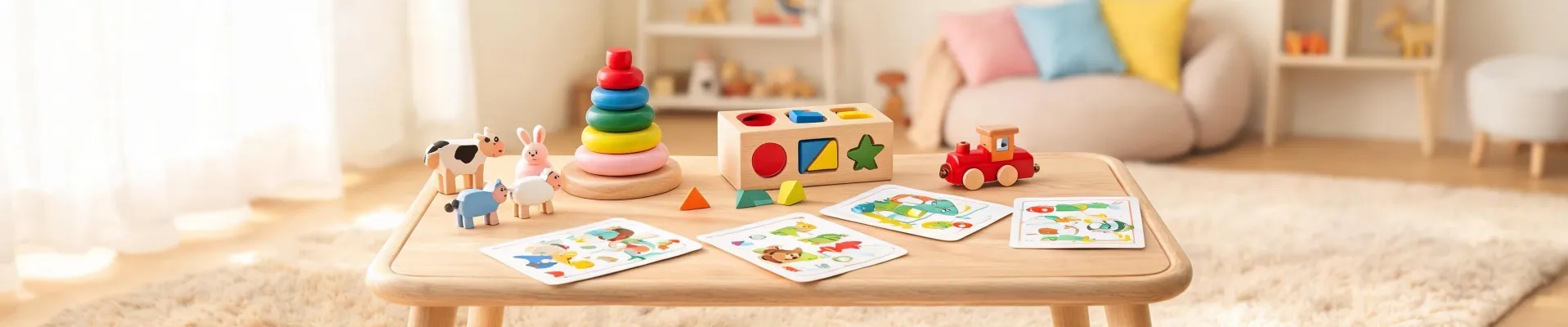
Hape My First Wooden Blocks Review: What Matters Most for Toddlers
2026-08-24 by Miriam Adler
Choosing your toddler's first wooden blocks usually comes down to two options: a compact set from a brand you trust, with rounded edges and a clear safety story, or a bigger box from a lesser-known company, with more pieces and a lower price. The second looks like the better deal—until you stop to ask what an 18-month-old actually needs. This guide turns that vague comparison into three concrete criteria, so you can decide with confidence rather than by sticker price.
The First Blocks Dilemma: What Should You Actually Compare?
Picture your 18-month-old in the middle of the living room, grabbing everything within reach and testing it with his mouth. You have two block sets pulled up on your phone. One is a compact set from a familiar brand, with rounded edges and a price that sits just below what you hoped to spend. The other is a larger box from a name you don't recognize, with more pieces, brighter colors, and a lower sticker price. Your first instinct is to pick the bigger box—more blocks for less money always seems smarter. But then you notice the small parts warning, and you wonder if the extra pieces are actually a risk rather than a benefit. This is the dilemma that causes so many parents to choose wrong: they compare piece counts and prices, which are easy to see, while ignoring safety and fit, which are hard to see. The solution is not to become a toy expert, but to replace the vague question 'which is best?' with three specific ones you can answer from any product listing. That's what the rest of this guide does, in a way you can reuse every time you shop for a toddler toy.
Drop piece count and price from the top of your list, and three criteria should carry the decision. Safety comes first: what is the toy made of, and will it survive a toddler who chews, drools, and throws? The second is developmental fit: can your child grasp and stack these blocks now, and will the same pieces still challenge him in a year? The third is long-term value: will this set still get played with in six months, or will it end up in the donation bin? These three questions turn a blurry 'which blocks are best' into a structured choice. Hape's official materials list sustainably sourced wood and non-toxic paints, which addresses the biggest safety worry for a mouthing child. Sustainably sourced wood generally comes from managed forests, and non-toxic paint avoids heavy metals—both matter for a chewer. That's a solid baseline, but a safe set can still be too small or too boring. So the developmental-fit question checks grip size and the range of play, while the value question makes you think in cost per use instead of sticker price. If a set supports two years of play, a higher upfront price can beat a cheaper toy that gets ignored after a week. With those three filters, you can approach any product page with a clear head.
What's Actually in the Wood: Safety and Materials
Start with the wood itself, because it determines whether you'll worry every time a block travels from the floor to your child's mouth. Hape states that its toys use 'Child-Safe Materials Made by sustainably sourced wood and non-toxic paint.' That sentence is worth pausing on. Sustainably sourced wood is not a guarantee of safety by itself, but it usually means the timber comes from managed forests with fewer chemical residues, and the manufacturing process is more likely to be monitored. Non-toxic paint is the more tangible promise: it should not chip easily, and even if a piece gets chewed, it won't release harmful substances. That doesn't mean you can skip inspecting the set. Run your fingers across every edge; a well-made block will have smooth, rounded corners and no splinters. Check that the paint is fully cured and doesn't flake off when you rub it. For a child who is still mouthing, the real safety test is not the certification sticker—it's how the block feels after a month of being dropped, chomped, and dunked in a cup of water. Hape's material claims give you a strong starting point, but the responsibility for daily checks stays with you.
The mouthing behavior of an 18-month-old is the true context for any first block set. At this age, children don't just look at blocks; they bite them, throw them, and try to fit them into every available opening, including their own mouths. That means the two most important physical traits are size and durability. Blocks need to be large enough that they can't be swallowed, even in the smallest open space, and sturdy enough that they don't break into jagged pieces under pressure. A good rule of thumb is simple: if a block fits entirely inside a toilet paper roll, it's too small for unsupervised play. Piece count should not override this. A 50-piece set with tiny blocks may look like more value, but it's actually a greater risk for a toddler who still explores by mouth. Hape's My First blocks are sized for toddler hands, which usually means they're comfortably big—about the size of a small adult palm or larger—and that reduces both choking risk and the chance of a painful throw landing. Checking for small parts isn't just looking at the pieces; it's also about checking the finish, the seams, and any attached stickers, which can peel off and become a hazard. If the toy survives a week of regular toddler abuse without losing pieces or paint, you've passed the real test.
Does It Grow With Your Child? Stacking, Sorting, and Beyond
Blocks need to grow with your child, and the arc of block play is predictable. Around 12 months, a child loves knocking over a tower you built. By 18 months, she tries stacking two or three blocks herself, often with more enthusiasm than accuracy. Between 24 and 30 months, sorting by color and size begins, and by age three, she's making bridges, animals, and imaginary houses. An open-ended set of simple wooden shapes can ride that entire arc because it doesn't dictate one activity. Hape's design philosophy emphasizes toys that encourage imagination and problem-solving. The company says its toys and curriculum are used in more than 5,000 schools and have won over 300 international awards, including the Red Dot Design Award and Spiel Gut Certification. Those numbers tell you the design has been stress-tested by educators and critics, not just market-tested. That doesn't guarantee your child will love the set, but it does mean the blocks are likely to hold up to repeated use and keep offering new ways to play. The blocks themselves are basic—rectangles, squares, maybe a triangle or two—so they can become a phone, a sandwich, a bridge, or a wall. That flexibility is what keeps the toy from becoming a dust collector.
The real enemy of long-term play is the single-purpose toy. A musical turtle that plays one tune holds interest for a week. A light-up cube may last a month, but once the novelty fades, it sits untouched because there's no new way to interact with it. Open-ended toys, by contrast, grow with the child because the child controls the play. A bag of simple blocks can be a tower one day, a stable for toy horses the next, and a sorting game at two-and-a-half. This is why a smaller set of well-made blocks often beats a larger set of gimmicky pieces. With one-press toys, the learning ceiling is low; with blocks, the ceiling is set by the child's imagination. The same set that supports a wobbly two-block tower at 18 months later supports a four-story building, a pretend zoo, or a counting lesson. That trajectory explains why a set like My First Blocks can stay relevant for two or three years, while a flashier toy burns out in weeks. When comparing a 30-piece basic set to an 80-piece set with action features, ask which one lets your child be the author of the play, not just the audience. That question separates lasting value from a short-term distraction.
How It Compares: My First Blocks vs. Other Options
The first thing you'll notice is that Hape offers multiple wooden block sets, from compact toddler sets to larger collections. The catalog includes an 80-piece wooden block set and Maple Wood building blocks, which raises an obvious question: why choose a smaller 'My First' set when the same brand sells an 80-piece box? The answer is age fit. The 80-piece set is a better match for a 3-year-old who can handle more pieces and a wider variety of shapes. For an 18-month-old, an 80-piece box is overwhelming—harder to find the right piece, easier to scatter everything, and more likely to lose small parts. The 'My First' sets are intentionally leaner, with fewer, chunkier pieces that are easier for little hands to grasp and easier for parents to keep track of. So the comparison isn't 'Hape vs. generic blocks'; it's 'Hape My First vs. Hape 80-piece' and then 'Hape vs. alternative brands.' When you lay out that comparison, the price difference between an 80-piece set and a 20-piece set stops being a pure value metric. Instead, you ask which set fits your child's stage. A larger set isn't automatically better; it's only better for a child ready for it.
Let's apply this to a realistic profile: a 19-month-old who moves quickly, inspects everything, and has started stacking board books. Your budget is around $100, and you're torn between a compact, safety-reputed set and a larger, cheaper box from an unknown brand. With the three-criteria framework, safety comes first: does the unknown set list its materials? If not, that's a red flag for a set that will be chewed. Developmental fit is next: your toddler is still mouthing and throwing, so chunkier blocks in a smaller set actually match better than a sprawling collection. Long-term value: the cheaper set may cost less today, but if it chips, cracks, or gets abandoned because the pieces are too small to work with, the cost per use climbs. In that scenario, the safer, chunkier set wins even with fewer pieces. Now invert the profile: a child turning three who already builds detailed towers and owns a basic block set. For that child, a larger set with more variety adds real play value, and a compact 'My First' set would be a step back. So the decision rule is conditional, not a brand loyalty test.
Your Call: The Decision Rule for Buying Hape My First Blocks
Here is the bottom line, stated as a rule you can apply without a spreadsheet. Buy Hape My First Wooden Blocks if your child is between 18 and 24 months, if this is the first block experience, and if your priorities are material safety and open-ended play. Skip it and go bigger if your child is already 3 or older, if you already have a basic set of blocks, or if your child needs wheels, connectors, or themed pieces. The 'My First' design is intentionally a beginner set, and that's its strength. Hape's broader line includes more advanced wooden toys, so if your toddler moves quickly, the brand provides a natural upgrade path rather than a dead end. The design awards and school adoption—5,000+ schools and 300+ international awards—tell you the play patterns were considered carefully, but they don't override your specific situation. For an 18-month-old, the set's chunky shape and safe materials are worth more than raw piece count. For a 4-year-old, the same chunkiness becomes a limitation. That's the entire decision in two sentences: choose the set that matches the child's current manipulation skills, and make sure the material claims are clear. If those two conditions are met, you've solved the dilemma.
Now return to the original screen, where two block sets sat side by side. You know the first question to ask is not 'how many pieces?' but 'what is this made of, and can I see a clear material statement?' From there, you check whether the set matches your child's current age—not the age on the box, but the way your child actually plays. A 60-piece set can be a poor first choice if your toddler still mouths everything, just as a compact set can be a poor choice for a preschooler who needs complexity. The rule we've built steers you to the right side of that trade-off. If you're shopping for an 18- to 24-month-old and you value safety and open-ended play, Hape My First Wooden Blocks is a defensible pick. If you're shopping for an older child or a second set, look at larger systems or feature-rich sets. That's not a vague compromise; it's a concrete rule you can take to any product page. The dilemma isn't about which brand is 'the best'; it's about which set is best for the specific child you're buying for. Keep that focus, and you'll walk away with something that gets used, not something that gets stored.
The safe, chunky My First set wins for 18- to 24-month-olds; a larger or more complex set wins for 3-year-olds or second sets. That's the rule.
Miriam Adler
Miriam Adler is an educational and STEM toy analyst specializing in busy boards, Montessori-style manipulatives, learning towers, sound books, reading pens, pretend-play sets, and early learning toys. She applies ASTM F963 and IEC 62115 methods while evaluating small-part hazards, accessible edges, switch durability, sound output, battery access, pull force, and age-appropriate task complexity. Her work helps parents, retailers, and product teams choose learning products that align developmental goals, supervision needs, interaction design, and the intended age stage.